My Blog List

Showing posts with label Art and Architecture. Show all posts

Wednesday, September 11, 2019

Exhibition on human migration and refugees at the Phillips Collection

Friday night Pam and I met my art history class to see an exhibition titled "The Warmth of Other Suns: Stories of Global Displacement. "The class is on art and war, so the exhibition was an appropriate assignment since many people have been uprooted from their homes by warfare although economic and environmental factors have also been important in creating refugees.

The exhibit consists of paintings, photographs, sculptures, films, and videos and was too much to fully take in during the time we were there. Even so, what we saw has given me plenty to think about since. Apparently the other students felt much the same because we spent an hour in class yesterday discussing the exhibit. I shared with the class my thoughts on the part that made the biggest impression on me--the inclusion of Dorothea Lange's photos taken during the Great Depression.


"Migrant Mother" by Dorothea Lange

I've felt that the antipathy towards immigration was largely a result of xenophobia, racism, and perceived economic threat. What was so striking about Lange's photos is that the people who fled the Great Plains for California during the 1930's were largely native-born Protestants whose families had been in the country for generations. I know from John Steinbeck's novel The Grapes of Wrath, which is considered an accurate portrayal, that they encountered hostility from Californians, generally people from the same ethnic stock, when they arrived. "An Okie used to mean you were from Oklahoma," one of Steinbeck's characters said, "Now it means you're scum." Obviously, racism and xenophobia can be ruled out as causes for this antagonism, and it's hard to lay the blame purely on competition for jobs since the migrants took the lowest paying jobs as agricultural workers, jobs that most Anglo-Californians spurned.

From the class discussion that followed, I conclude that it seems to be a common human reaction to object to the arrival of newcomers, whatever their ethnic composition. The professor pointed out that when Germany was reunited at the end of the Cold War, West Germans complained about East Germans. I later recalled being part of a merger between two large American corporations where the employees of one of the legacy companies complained about the employees of the other legacy company. We were all American businessmen, but those from the other company became "the others," just as foreign as if they had arrived from another world.


Tuesday, June 5, 2018

A Day of DC Art Galleries

Pam and I took the subway into town where we visited four different art museums today. The first stop was the Renwick Gallery which was showing an exhibit titled "The Art of Burning Man".

Many of the pieces were interactive and in the temple shown below visitors are encouraged to write messages on pieces of wood that will be incorporated into the exhibit:


These two are also from the same exhibit:


From there we walked to the Mall to the Freer and Sackler Galleries. Since we were playing tourists today, I took a picture of this DC landmark while we crossed the Mall:
 
 
In the Sackler Gallery the exhibit of colorful fabrics some Central Asia called Ikats caught my attention. In this display, some are hundreds of years old and others are modern garments inspired by Ikats:
 
 
Our last stop was the Museum of African Art which had many interesting items, but of the pictures I took I liked this one of the stairway best:


Thursday, April 12, 2018

Something new in the Art/Sociology Building

Also called the Parren Mitchell Building at the University of Maryland, it's interior always seemed striking to me. Now they've added this multicolor work under the skylights in the atrium either temporarily as an exhibit or possibly as a permanent fixture.


This is the effect from straight below:


Viewed from the second floor, it looks like this:

Tuesday, December 26, 2017

Vermeer exhibit at National Gallery of Art


It was a real family affair. Pam and I met Rebecca, Sean, and Sean's parents to see the paintings. "The Geographer is of my favorites:


After leaving the museum we all had a nice meal at a restaurant downtown.

Thursday, October 26, 2017

Visit to the National Gallery of Art on Tuesday


My art history class saw a lot of 19th century works, and my favorite were the British landscape painters.

J.M.W. Turner:


 And John Constable:


Monday, May 22, 2017

Another New York Weekend

We began with a visit to the September 11 Memorial in lower Manhattan on Friday, and here I am with daughter Rebecca:


The World Trade Transportation Hub, the Oculus, is a striking and controversial design which serves as a shopping mall as well as a train station. I liked it and so did Rebecca who said the light and openness contrasts with most of the city.

 
In addition to seeing Rebecca and Son-in-Law Sean, the Georgia O'Keefe exhibit at the Brooklyn Museum was the highlight of the trip. Her painting of the New York skyline seems appropriate to include:
 
 
As well as a painter and feminist icon, O'Keefe was a popular model for photographers throughout her life. Here she playfully peers through a piece of cheese while sitting in a car.
 
 
The Dinner Party was a related exhibit honoring the feminine throughout pre and recorded history with each place-setting symbolizing something different, and the final setting is for Georgia O'Keefe as a symbol of women's creative expression. I failed to record the symbolism of this place-setting. I just liked the look.


Pam, Rebecca, Sean, and I walked to the nearby Brooklyn Botanical Gardens after leaving the museum. Here's the young couple:


Sunday morning I was attracted to the sunlight in the courtyard as viewed through the window screen of the Air B&B apartment we rented:


Before the trip I checked my notes on skyscrapers from the architectural history course I took a few semesters ago, and two items that I wanted to see were the lobbies of the Woolworth and Chrysler buildings. Neither were available for a thorough visit, but we were able to briefly get into both. In the Chrysler Building on Sunday, I was able to take a photo or two, and this one gives a sense of the appeal of these lobbies:

Monday, April 24, 2017

National Building Museum

For some time my old friend Larry has suggested that I visit this museum where he has been a docent since retiring as a librarian, so last Wednesday I took the Metro downtown with him. Getting off the train at the Judiciary Square stop, you see the building right in front of you as you get off the escalator. Built between 1882 and 1887, the building's brick exterior catches your eye, and I really should have gotten a picture of it.

However, I did photograph the interior atrium which they call the Great Hall and is spectacular:


The photo taken from the top floor doesn't really do the interior justice. The Great Hall is larger than a football field and appropriately has been used for many Presidential Inauguration Balls, the first for Grover Cleveland before the building was even completed.  The building was originally constructed to house the US Pension Bureau and has been used by other government departments before being restored to serve as a museum. The original architect/engineer was Montgomery Meigs who had been a general in the Union Army during the Civil War.

Hearing about one particular exhibit finally motivated me to make this visit. The exhibit showed the history of St. Elizabeth's insane asylum where my father worked for many years. I have memories of visits there when I was a child and he brought me to work with him for various reasons, and the exhibit brought back many of those memories. I also got a sampling of some of the other exhibits, enough of a sampling to make me want to return for another visit.

Friday, March 24, 2017

Fallingwater


Tuesday Pam and I drove up into Pennsylvania to see architect Frank Lloyd Wright's famous house that he designed for the Kaufman family of Pittsburg. The photo above is the shot which most tourists take and has become the standard representation.


The Kaufman family owned the mountain property and hired Wright to build them a
vacation home next to a stream. The stream, Bear Run, looked to me like a classic eastern trout stream as it tumbles down the hillside. Rather than blindly following his client's wishes, the architect proposed cantilevering the house over the water.


Looking downstream, this photo shows the stream as it passes under the house just before the water falls:


Although I have read about the house and seen the standard pictures, it really fits into the classification of things you have to see in person to appreciate. I recently took three semesters of the history of architecture, and more attention was paid to Frank Lloyd Wright than any other person. After visiting Fallingwater I have greater appreciation of his genius.

Thursday, December 1, 2016

Words and images

A course I took a few years ago entitled "Why Poetry Matters" made me think about how much poetry surrounds us in the way of song lyrics. Most of it is bad poetry, I would admit, but it's poetry nevertheless. In addition to song lyrics, we are bombarded with words constantly from radio and TV in addition to from people in our work and personal lives. Regarding written communication, the internet has added a huge amount on top of traditional newspapers, magazines, and books.

In a similar fashion, the art history course I'm currently taking makes me muse about how many images modern humans see daily. Movies, television, publications and, once again, the internet give our eyes a constant stream of images. With a few keyboard strokes, people can view images of the paintings of the great masters that once were available only to the select few owners and their friends.

I have read that it's been estimated that about 80 billion humans have lived on earth. That estimate depends on, among other factors, the length of time Homo Sapiens have existed, but I believe the current generally accepted figure is 250,000 years. What is certain is that for most of those years the amount of words and images available to humans was infinitely smaller than what it is today. The images drawn on the walls of caves in Lascaux 17,000 years ago and in Chauvet 30,000 years ago must have been regarded as precious to those who saw them. The number of animals in the Lascaux paintings have been speculated to represent either past hunting experiences or rituals to bring about the success of future hunts. Words were scarce as well since it's been just a few thousand years that they have been stored in writing. Oral story-telling was valued, and I envision extended families huddling around a fire at night listening to a practiced speaker recounting old tales of valor. This is how the Homeric epics were handed down.

So now we're comparatively wealthy in words and images, but maybe that abundance has cheapened the product. Here, I'm thinking of the internet again. Anyone with a computer can throw words out there, and a great deal of that content is simply false while much of the rest is cruel, crude or both. (I'm not oblivious that I'm adding to the total.) Images flood us as well, both still and motion, but the value of certain iconic images gets diminished in that flood. A few weeks ago in the art history class, we were analyzing Di Vinci's "Mona Lisa", and I realized the masterpiece has been reproduced and parodied so often in my lifetime that studying it as a painting was difficult for me.

Being provided with so many words and images makes us not spend time on any one of them. Often I hear complaints that people don't fully read e-mails and miss important points. The average museum visitor spends about 17 seconds on each work of art they view. We feel we have to hurry through all these words and images, so we have trouble adjusting to the ones that deserve plenty of time. The professor of the poetry class recommended letting a poem "flow over you" without getting too hung up on trying to figure out the meaning of each line and then going back for analysis. The art history professor had us study an established six step process: look, observe, see, describe, analyze, and interpret, with each of those steps explained.

Maybe the rule should be to devote the time to taking in an image or a written or oral statement as appropriate to how much time was expended in the creation.


Sunday, September 11, 2016

Art in the afternoon, baseball in the evening

Yesterday, Pam dropped me off to take the Metro to Dupont Circle to join my art history class at the Phillips Collection which featured an exhibit by the American impressionist painter William Merritt Chase. Not surprisingly, the painting which most attracted my attention was titled "The Lone Fisherman".


For a painter classified as an impressionist, many of Chase's works show sharp detail in spots, such as the rocks in the foreground here. In the distance the single human appears small and isolated. I noticed that Chase's outdoor scenes invariably contained man-made items such as the breakwater jetty which dominates this picture.

After leaving the art museum, I got back on the Metro to travel to Nationals' Park to meet my neighbor Jim for a baseball game.


Harper homered in the bottom of the eighth to give the Nats a 3-0 win over the Phillies. Although very hot, it was a good day and certainly a full day.

Monday, July 4, 2016

Three images

Last Wednesday and Thursday we toured four art museums in New York City with daughter Rebecca. Two paintings in particular, quite dissimilar, reminded me how different it can be to view originals as opposed to reproductions in books and on the internet.

The first is Picasso's very famous Les Demoiselles D'Avignon.
Although I've seen this work before, this time I really stared at it intensely and let it flow over me. Whether I focused on the women or the surroundings, I found it a very satisfying visual experience. Even if the painting had been a total abstraction without any recognizable content, I'd find the design and overall effect pleasing, and I think I could look at it everyday without tiring of it.
 
The second is a painting I hadn't seen or heard of before, Landscape with a Footbridge by Jacob van Ruisdael, a 17th century Dutch artist.
 
 
Apart from the scenery and the lighting, my attention went to the human figures in the lower center, not the humans and horse to the left. The two who would attract the attention of any outdoorsman are lost in the shadows and are barely visual on my computer monitor. One is on the riverbank fishing, and the other is carrying a gun and is clearly in a stalking posture as if intently in pursuit of game. The prey may be in the woods on the other side of the bridge or could be the ducks which appear only as dots under the bridge in this small reproduction. The fisherman has his head turned as if surprised by the presence of the hunter. Maybe he's afraid the commotion might spoil the fishing. It's another painting I'd not grow weary of.
 
The final image is a photo of son-in-law Sean, Rebecca, and Pam in Brooklyn along the East River with the Williamsburg Bridge in the background. It was taken before dinner, and I liked the early evening light.


Thursday, December 3, 2015

All in an afternoon on campus

First I attended a performance of a Bach Cantata at the Clarice Smith Center for the Performing Arts. These take place a couple of times a semester, and there are very few things that can lift your spirit like hearing a beautiful choral and orchestra piece performed live at mid-day. Back in November 2012, I took a number of photos at a similar event, so I didn't today. I just sat and soaked it in.

Next I had planned to view a new exhibit of faculty art at the Art Gallery in the Art/Sociology Building. I knew that the building was going to be re-named for Parren Mitchell, but I didn't realize the dedication was today. I remember the late Mr. Mitchell well as the first African-American Congressman to represent Maryland but had forgotten until today that he actually was the first of his race to attend the University of Maryland in the early 1950's. He had to go to court to get that right despite being a WWII veteran who was awarded a Purple Heart. Since I was living in Maryland at that time, it made me feel old to realize I had lived through so much history.


After the ceremony, I had a few minutes to view the art exhibit before proceeding to my History of Architecture class. You can pack a lot of variety into one afternoon at a place like the University of Maryland.

Wednesday, March 4, 2015

Visit to a Gothic Cathedral

Since this semester's History of Architecture has been studying Gothic Cathedrals, I've been eager take a new look at the closest example, the National Cathedral in DC.  This morning I drove down and took in the standard 30 minute tour.

As I knew beforehand, the building has been under repairs from damage done by the 5.8 earthquake in 2011, and the construction noise occasionally made it difficult to hear the docent.  Much of what I heard I already knew but not everything.  For example, I hadn't realized that the site was selected because of the relatively high ground.  Although all the examples we've studied in class are in Europe, the Washington Cathedral design follows the standard cross shape with an east-west layout so service goers are praying while facing east, towards Jerusalem. 

I had a chance to look at the standard Gothic features such as pointed arches, ribbed vaults, and flying buttresses and appreciate the beauty of the stained glass and sculptures.  Because of the construction, I took only one picture, that of the stained glass in the Maryland Bay:


Recently I went back to look at my notes from a class a couple of years ago entitled History of Science and Technology because I remembered an excellent lecture on Gothic Cathedrals.  The professor made the point that technology is not neutral but rather is a reflection of the concerns and aspirations of the surrounding culture.  The religious nature of the Middle Ages caused the people to direct their intelligence to building houses of prayer with high interiors to direct attention towards heaven and to include as many windows as possible because light was equated with God.  Since the building material was stone for permanence, the engineering challenges of handling the stress of the weight lead while allowing for windows lead to the solutions we see in the Gothic architectural design.

I'll probably come back when the construction is complete and the weather's warmer.

Monday, December 29, 2014

History of Architecture I

Enjoyed this class and plan to continue with the next two courses in the proper chronology.  This course began in prehistory, goes approximately up to 1000 AD, and covered a multitude of building types including Sumerian ziggurats, Egyptian pyramids, Greek and Roman temples,  Byzantine and other early Christian churches, mosques, and Buddhist temples in India, Sri Lanka, and China. 

We learned about various building materials such as wood, mud brick, stone, and concrete; lots about concrete.  Although residential building has historically been done with materials such as wood which will decompose over time, the instances where sufficient remains survived were of particular interest to me for the same reason that I like looking at paintings of the Dutch Renaissance- because we get a glimpse of how people lived their daily lives.

One very old example of an ancient village has been uncovered in Turkey, Catal Huyuk, which goes back 8-9,000 years:

As the above re-creation shows, these people lived in attached structures much like a modern apartment building except entrance to each unit was by ladders through the roofs.  The entire village is thought to have had a population of about 10,000.

The population of a village from centuries later, Herculaneum, were all killed by the same volcanic eruption that destroyed nearby Pompeii in 79 AD.  Although Pompeii is the better known of these two Roman towns, more residential material survived in Herculaneum because the super-heated pyroclastic flows preserved wooden objects like roof tops, beams, beds, and doors for reasons I don't understand because we weren't studying archeology.  The ash from these flows is as thick as 60 feet, so it is understandable that 75% of the town is still buried.


Atrium houses were among some of the remaining types of residences of Herculaneum.  The structures also contained the family business that was advertised on the wall facing the street.

Taking courses in architecture effects how I look at buildings and other structures,  especially as I walk or drive through cities.  It increases my understanding and appreciation.


Tuesday, September 23, 2014

Sculpture outside the Architecture Building

...at the University of Maryland.  I walk by it and couple of times a week, and every time I have to stop and stare.  I really like it.


Friday, November 16, 2012

Camille Paglia, Johnny Cash, and Johann Sebastian Bach

When I awoke yesterday morning, my wife strongly recommended that I listen to an interview with Camille Paglia, the controversial commentator on art, politics, and anything else that strikes her fancy, so I accepted the ear bud to her MP3 player and listened while in bed.  Among other comments, Paglia criticized art academics for their secular humanist scorn for anything religious.  Although herself a skeptic of traditional religion, Paglia maintains that religious fervor has produced some of the greatest art in history and to dismiss it is to lose something vital in Western Civilization.  I can't say that her words influenced how I had planned to spend my day, but when I returned home in the evening I reflected how my day contained significant doses of both art and religion.

After my morning geology class and lunch at the Student Union, I walked to the Clarice Smith Center and there I listened to a brief mid-day concert of Bach's NUN Komm, Der Heiden Heiland BWV 61 inspired by passages from The Gospel of Matthew and other parts of the New Testament.  "Music's only purpose should be the glory of God and the recreation of the human spirit"  Bach once said, and while I don't know if any Creator felt glorified, I felt my spirit uplifted by the voices and the instruments.


In the foreground below is one of the featured soloists.  That most of the performers were in their regular street clothes made the event casual, as if an interlude of beautiful music should be a normal part of the weekday.


For a version of this work click here

After that I proceeded to the campus Art Gallery for the new exhibit "What It Is, What It Was:  Music Video As Art."  When I was a young man in the photographic industry, there was general agreement that combining rock music with visual images was going to be big, but when MTV arrived I was disappointed with the quality of the short films being created for the music and haven't watched many of these videos over the years.  I never even got around to watching a widely praised one by one of my favorite singers, Johnny Cash, although it's been around now for ten years.  I got my chance yesterday because Johnny Cash's "Hurt" is one of the videos chosen to be projected wall size as part of the exhibit.  Ms. Paglia would have approved because Christian imagery is a major component and is appropriate because Cash was an intensely religious man.


To watch this video, click here

Radiohead, R.E.M., Tom Waits, Kanye West and other recording artists are also featured in the exhibit.  I spent about an hour there and plan to return.  It's art as far as I'm concerned and worth serious looks and listenings.

Friday, September 14, 2012

Friday: National Cathedral

In the summer of 1974 I taught camping skills at a day camp on the Cathedral grounds.  In those days, there were thick woods directly behind the building, and coming out of them and beholding this Gothic structure was an odd sensation something like being transported suddenly to Medieval Europe.

I don't believe I've walked around the grounds since then, and many things change in 38 years.  The land is now mostly developed with parking lots and athletic fields for the schools associated with the Cathedral.  What remains of the woods is no longer wild but more of an urban park.  I tried to capture some of the feeling I once had with these two pictures taken from the same place.

First I photographed the Cathedral:


Then I turned around and took a picture of the
wooded parkland:


I was a little shocked to realize that those 6 to 10 year olds that I taught knots and fire making are now well approaching middle age.

Wednesday, April 18, 2012

Foundations of Architecture

In the last few weeks of this class, we've been focusing on creating hypothetical changes for the Journalism building, one of the newer structures on campus.


My changes evolved into a greenhouse with an entrance from the atrium under the stairs. There would be brick walls leading into the greenhouse which would have a matching brick wall. Each wall would also serve as a planter for small shrubs.


Wednesday, February 8, 2012

University Art Show


The "Wood, Paper, Fiber" exhibit is currently being shown in the gallery in the Art and Sociology Building. I really like the interior of the building which is pictured above.


Drew Goerlitz: "Propositum III" He's a Maryland graduate, and all his works shown in this exhibit are made from steel and paper.


"Vessel" by Millicent Young who lives in rural Virginia. That's horse hair hanging down.
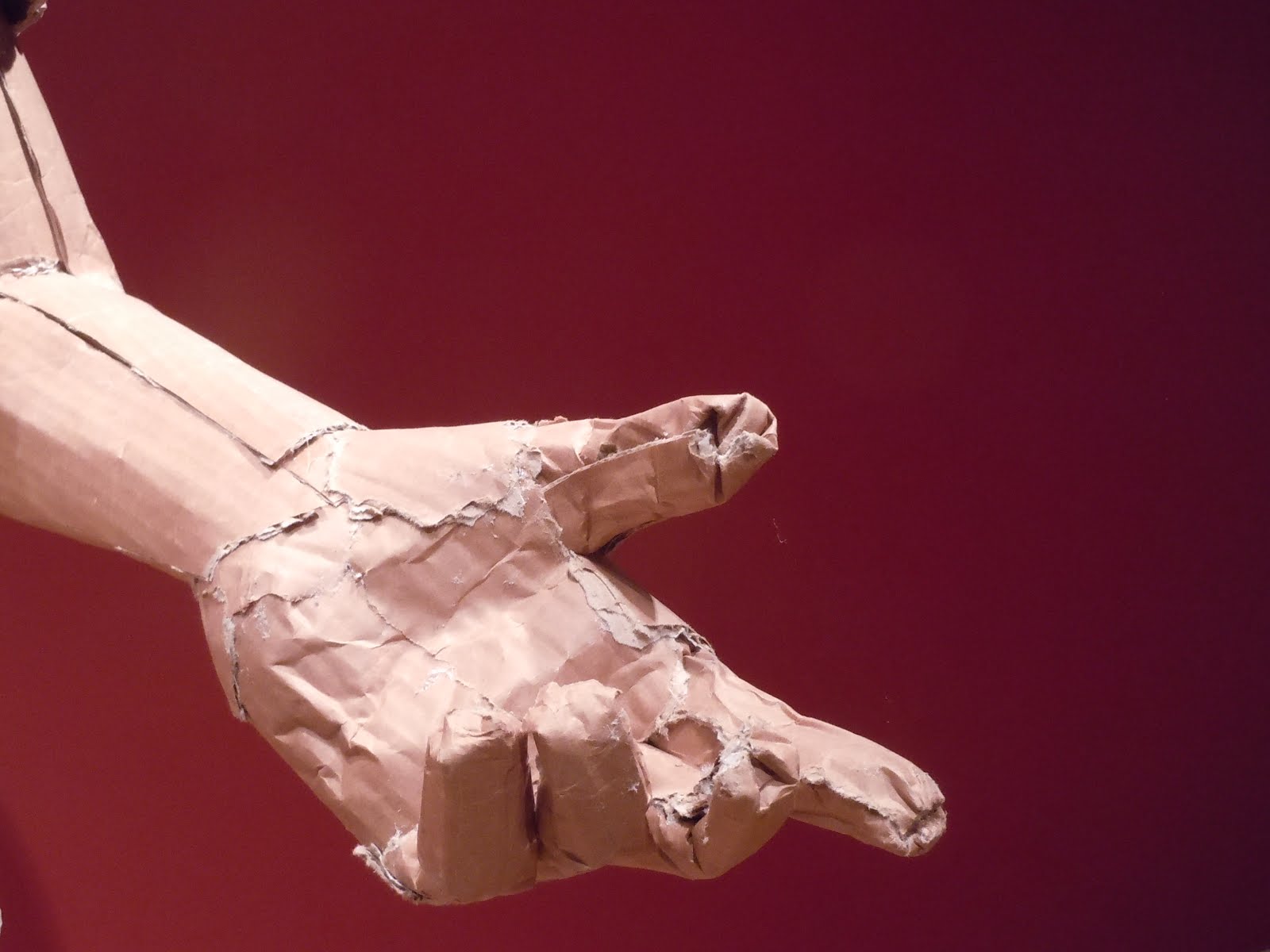
"Globe" by Englishman Chris Gilmour using cardboard:Drew Goerlitz: "Vascellum"


"Monstrare II" by Drew Goerlitz


"Julius Ceasar" by Chris Gilmour


Close-up of the cardboard materials:


Curator Prof. Foon Sham says the artists "Skillfully transform these materials into art of great beauty and deep resonance."

I feel that way about this untitled work by Aeneas Wilder of Scotland: