My Blog List

Saturday, April 2, 2016

Early April walks in the park

First in the afternoon:
Then the evening:


Thursday, March 31, 2016

First fishing of the year

Although "opening day, for trout fishing was Saturday, I didn't get out because I wasn't feeling well. I was feeling better on Sunday, and caught a trout and a largemouth bass in about an hour of fishing. I used a spinning rod and a Mepps in-line spinner. I got another trout the next day, so we had enough for a fish dinner that night.

Then yesterday we had one of the few days lately of light wind, and I took advantage of it to try the fly rod. Using a marabou bead-head, I caught a really pretty good-sized crappie which I probably should have kept or at least photographed. I then caught another trout which I did photograph. It's indicative of the other two I've caught so far.


Sunday, March 20, 2016

Vernal Pools

The latest issue of Virginia Wildlife magazine contains an article about vernal pools. Although I hadn't heard that poetic name before, I knew exactly what they were because I often encounter vernal pools while walking in the forest to a trout stream in the late winter or early spring.

Vernal pools are temporary bodies of still water and begin forming after trees lose their leaves in the fall and their need for water diminishes. The additional water in the surrounding soil fills natural depressions on the land creating a vernal pool. The pools continue to collect water during the winter and spring but generally dry out and disappear in summer. Vernal pools may vary in size from a few square feet to multiple acres. Their ecological function is much like wetlands because that's what they are. Like other wetlands, vernal pools serve as birthing areas for animals but, because of the pools' temporary nature, the animals are generally limited to fast-maturing amphibians such as salamanders and wood frogs.

On my walk today, I went down into the Paint Branch stream valley to photograph a small vernal pool there:
 
 
I know some larger ones less than an hour away, and maybe I'll get around to photographing them sometime this spring.
 
On the walk home, I stopped back to check on the ring-necked ducks that have been there since last month. Originally there were four plus a redhead duck who hung around with them. Now the other males have moved on probably because, as Pam puts it, the lady duck has made her selection.


Saturday, March 19, 2016

Looking at Birds

Pam and I are not birders although, like most people who enjoy the outdoors, we look at birds and try to identify and understand what we're looking at. My friend Larry Fox who died last year was the only real birder I knew, but I never really questioned him about his past-time although we sometimes went out into the wild together, he with binoculars and me with a fishing rod.

I have the impression that the term "birding" gained favor over "bird-watching" because some people didn't like the image of the old term which seemed to be presented in movies and TV as a predominantly feminine hobby that was often the subject for ridicule. Maybe when more men got interested in the activity, they decided they wanted to be identified with a new term that would be viewed as active rather than passive. Larry was a thoughtful person and would have had something to say about this, so I'm sorry I never got around to asking.

On a walk in the park recently, Pam and I encountered a woman who was obviously an enthusiastic birder. She told us about an on-line site where a person could instantly file a report about the species observed and the time and place. She said that an observation made from indoors, such as looking out from your house at a bird feeder in your yard, had to be so indicated, and she implied that such reports were somehow viewed as lesser than reports made from a person outdoors. At home we visited the site (ebird), but we didn't note such distinctions which may only be apparent when you actually complete the on-line form to submit a report. However, we did find the report the woman submitted that day, and she noted 18 species in an hour of viewing in the park.

The birder also mentioned that "our" park had been designated as a "hot spot" for seeing birds. That's nice to hear, and it's also nice that we now have an internet site to visit occasionally to see what the experts have seen there which we may have missed.

Tuesday, March 15, 2016

Hint of green in the woods

Some leafing out is starting along Paint Branch.


Not much green here, but I like the scene:

Monday, February 29, 2016

Consolidated list of diving duck visits to the pond

The normal waterfowl at the pond are the Canada Geese, who are there almost all the time, and Mallards who visit often. Those we tend to take for granted while unusual visitors are noteworthy, and we tend to haphazardly record the sightings. The haphazard recordings are either on this blog or on scrap pieces of paper placed in one of the bird books we used to verify the species, and are usually diving ducks.

March 3, 2007: Ring-necked ducks

February 17, 2008 to April 26, 2008: Ring-necked ducks

December 26, 2011(and three weeks prior): We believed the single duck was a Lesser Scaup

January, 2012: Ring-necked duck

November 24, 2014 (and 3-4 weeks later): Hooded Merganser

February 29, 2016: Five ducks total, one with a bronze head which appeared to be a Redhead duck. Three of the others appeared to be male Ring-necked ducks, and the fifth was a dull brown color. It was almost certainly a female, but it could have been either a Redhead or a Ring-neck.

Saturday, February 27, 2016

Annual Crocus Pictures

Yes, I can't help myself from taking what are probably near identical photos every year, but they are such beautiful flowers and bring promise of warmer weather.


Wednesday, February 24, 2016

Foggy days

They present a different feel to familiar scenes...

Like the pond from the west side:


And from the east end looking west:


Saturday, February 20, 2016

Lefty Kreh at age 91


Here he's rigging up a fly rod in preparation for a casting demonstration at the annual Tiefest event on Kent Island.  That's the Bay Bridge in the background.

Lefty is probably the most famous fly fisherman in the world, and we're lucky that he continues to live in his native Maryland. He's a hero for many of us, a WWII veteran who fought in the Battle of the Bulge. I find him inspiring to be around and always learn something every time I watch him cast and hear his commentary. Also, he's funny as hell.

Thursday, February 18, 2016

Walking indoors

A few years ago my doctor recommended that I walk at least 150 minutes weekly which works out neatly to 1/2 hour, 5 days a week. I adapted well to this recommendation since I like being outdoors in the fresh air, and I usually do my walking in the nearby park which provides wildlife and plants to view. Pam sometimes goes with me and once or twice a week my friend Stan who lives on the other side of the park meets me in the middle. Having someone to talk with seems to shorten the time.

Before long I was considerably exceeding the minimum amount because I became addicted to the point that I feel uncomfortable on the few days when I'm unable to walk. Those exceptions usually occur because of obligations such as travel or multiple appointments. College classes don't pose a problem because I just do the walking on the large University of Maryland campus.

Weather is seldom a factor during the warmer months because walking in the rain doesn't bother me as long as I wear a rain slicker. Cold weather onto itself won't keep me from going out, but a cold rain or snow is something else. On such days during the school year I head for Cole Field House on campus where I encounter other walkers and runners on the concourse of the large athletic building. Unfortunately, Cole is undergoing a major remodeling which makes it unusable for these activities, and the Comcast Center which replaced Cole for basketball games is often restricted.

Fortunately, we have treadmill in our house which has been idle and collecting dust for years. Other household members have used it in the past, but I never developed much of a fondness for it. Recently, however, necessity has caused me to reconsider it. I've found that listening to music while using it relieves the boredom and works pretty well for me. Keeping the lights out in the room prevents me from focusing on the treadmill timer which detracts from the music and makes the time seemingly pass more slowly when it  grabs my attention.

Walking outdoors will always be my preference, but I'm glad I now have a tolerable indoors option.

Monday, February 8, 2016

Patuxent State Park in Winter

The Patuxent is the longest river which lies completely within Maryland's boundaries. Near the headwaters the river is a designated trout stream, and the surrounding land is a state park.

Although most of the park is forested, the section I prowled around this afternoon, near the Howards Chaple Road crossing, contains many open fields.


In the woods I came across this stone fence which goes back to when it was all farm land.


These sights make me wonder about how long ago the fence was erected and about the farm family who lived there at the time.

Monday, February 1, 2016

Will my life be changed?


I just finished reading Swann's Way, the first volume of Proust's In Search of Lost Time. Although this current translation of the overall title is more accurate to the original French, I prefer the original Remembrance of Things Passed as more poetic, which is no doubt because the phrase was lifted from a Shakespearean sonnet.

Whether or not I'll proceed to the other six volumes, I don't know. This first volume was over 400 pages, and the others must be about the same length because the total number of pages is over 3,000. Swann's Way stands on its own as a novel, so I don't feel a need to read further to attain a greater understanding of what I've read. Since I enjoyed it, however, I like having the option of reading the remaining volumes at any point in my life.

No, I don't think reading Proust will change my life, but I certainly had to adjust my reading style. The sentences are so long and the descriptions are so detailed that I had to go very slowly. That's a good adjustment for me because I normally have a tendency to read too fast which can lessen appreciation of good writing. Once I adjusted, I found that entering into Proust's world was worth the time.

The house after the big snow storm

I took the picture last Sunday before learning of my brother-in-law's death. Somewhat in excess of two feet of snow fell, and a week later although we've had a number of warm days much of it remains.

Sam Powell 1945-2016

Sam was married to my sister Elaine for 47 years. Since we all went to the same junior and senior high schools, I believe I've know Sam for about six or seven years before we became related by marriage. He was a wonderful husband and father and beloved by many.  He died a week ago Sunday, January 24, right after the big snow storm, and I still find it hard to accept that he's gone.

Thursday, January 21, 2016

Along Paint Branch after last night's snow

They're saying a bigger snow coming tomorrow.


Wednesday, January 20, 2016

Fox sightings

Many people I've talked to over the years agree with me that fox sightings are notable. The Red Fox, which is the species around here, tends to keep a low profile and is generally nocturnal or active mostly at dawn and dusk. Still, we have seen them from time to time ever since we moved into this neighborhood. The sightings are memorable also because the animal is so beautiful.

Yesterday was a big day for fox sightings for our family. Son Greg came into the house in the late morning and told us he had just spotted two in our front yard. Going on alert, Pam sighted them out the front window a little later. Shortly after that, I finally got into the act when Pam called my attention to the two foxes across the street although by the time I got to the window only one remained. When I took my daily walk into the park, I spotted one of them again but couldn't get my camera/phone out in time to get a photo.

I've since learned that foxes are more active now because January to March is their mating season, and although I have no records I believe most of our previous sightings have also been in Winter. One sighting a couple of years ago stands out in my memory.  I happened to glance out our front picture window and saw one trotting up our walkway about ten feet away. As is often the case, the fox was as surprised as I was when we locked eyes and instantly vanished. Another sighting was memorable because it came in mid-day and not in a setting near wooded parkland. I was in my car in the neighborhood but blocks away in the middle of the housing development when I saw him looping casually through front yards, in all his orange and white beauty, acting more like someone's pet dog than a wild predator.

No hidden treaures...

A few days ago I cleaned out my bedroom closet and removed old clothing to be given away to charity. Just now I went through the pockets of that clothing just in case something of value was left in any of them. I found:

matches
a valentine (from my daughter when she was in elementary school)
a handout from a business luncheon in 1999
a yarmulke (likely from a bar mitzvah)
lots of Kleenex

The handout and the yarmulke were in suit pockets. I'm keeping the valentine and the yarmulke.

Monday, January 4, 2016

Christmas tree: 2015

My annual decorated Christmas tree photo, shot a few days ago just before I took it down. Went with just close-up this year:

Wednesday, December 30, 2015

At Brookside Gardens with Rebecca and Sean


Nice to have daughter and son-in-law with us for a few days over the holidays.


Thursday, December 17, 2015

Counting Crows

Recently Pam and I have gotten interested in crows. In addition to the suet Pam puts out, we have started tossing bread, peanuts, and egg shells, and the birds come to feed in groups that can be as much as a couple of dozen.


Besides feeding them, we also are reading books about this intelligent species. Some of the well-documented stories are fascinating. One story concerns a husband and wife in Canada; she fed and spoke gently to the birds while he cursed them angrily. The crows were not only aware of the differing attitudes but also took note of the different cars each drove and bombed his car with their droppings while leaving hers untouched. Crows have been captured on film using sticks as tools to reach food and dropping nuts on highways so that the passing cars would run over them and break them open as the birds watched to retrieve the food when the car drove on.

One library book was not exclusively about crows but included information about local crows that we had known a little about. Thirty years ago I had an office that over-looked some trees along Montrose Road in Rockville. At sundown in winter an enormous number of crows gathered in these trees. It was a highly urbanized section of the suburbs then, and in subsequent years became even more so. Nevertheless, the crows continued to roost in that area to the dismay of many of the merchants in the nearby shopping centers. As part of her investigation, the author of this library book called an old man who grew up on a farm near Rockville, and he told her that he remembered the large massing of crows in that spot back in the 1930's when there was an airport there. The author was looking into the Montrose Road crows in the 1990's and raised the question that if the crows were behaving that same way 60 years ago can we speculate that they were also showing the same patterns hundreds of years ago?

Last Sunday, Pam and I set out a little before sundown to see for ourselves what was currently going on with the crows in that area. We spent a couple of minutes driving around near the intersection of Rockville Pike and Montrose Road without seeing any crows until we spotted a group just to our north. We parked in a shopping center lot directly under where they were flying, and to our delight we watched thousands of crows pass over us going west to east for the next 10 or 15 minutes.

Over the decades, the once agricultural fields gave way to office buildings, shopping centers, and high-rise apartments, but the crows continued to do what they had done before. The experience of this natural phenomena in this heavily commercialized area was both novel and exhilarating. Neither still nor moving pictures can truly capture this experience, but here is a video Pam took:


I don't like exaggeration, so I later worried about how to accurately describe the numbers we saw. The next day in the park I saw a group of migrating Canada Geese which were easy to count as they rested on the pond, and I counted 160 of them. I am confident that the evening before I saw 10, 20, or even 30 or more similar groups, so describing the total as thousands is justified.


Saturday, December 5, 2015

Two road songs: Thunder and Copperhead

When I'm doing my morning exercises I like to have the TV on, and Thursday I saw some of an old movie called "Thunder Road." I had seen it before, but I remember the title song much better. It was sung by Robert Mitchum who starred in the movie and was such a favorite in my neighborhood that the boys all sung it on the junior high school bus.

That part of the DC Maryland suburbs was full of families who after WWII moved there from small towns and rural areas, often in the Appalachian Mountains, and the story "about the mountain boy who ran illegal alcohol" (as the song lyrics go) was like a folk epic to many. We loved certain kinds of outlaws, and in the car culture of the 1950's and early 60's transporting moonshine in a hot car was about a cool an outlaw as we could imagine. Bruce Springsteen later wrote a song with the same name, and I've read that he took the name from a poster he had once seen of the movie.

Driving to the dentist a few minutes later, another song by Steve Earle came on the radio. "Copperhead Road" tells a story about a young man who could have been the son of the main character of "Thunder Road." He sings that his father and grandfather made moonshine, but after two tours in Viet Nam his plan was to grow marijuana in the same area of the surrounding Southern mountains- Copperhead Road. Having "learned a thing or two from Charlie", he warns, "you better stay away from Copperhead Road." He was ready to protect his illegal crop just as his father and grandfather had protected their whiskey still in the same woods.

I think I've observed before that Americans have often made folk heroes of criminals, going back to Jesse James after the Civil War, Bonnie and Clyde in the 1930's, and the continued popularity of the Godfather movies.

Thursday, December 3, 2015

All in an afternoon on campus

First I attended a performance of a Bach Cantata at the Clarice Smith Center for the Performing Arts. These take place a couple of times a semester, and there are very few things that can lift your spirit like hearing a beautiful choral and orchestra piece performed live at mid-day. Back in November 2012, I took a number of photos at a similar event, so I didn't today. I just sat and soaked it in.

Next I had planned to view a new exhibit of faculty art at the Art Gallery in the Art/Sociology Building. I knew that the building was going to be re-named for Parren Mitchell, but I didn't realize the dedication was today. I remember the late Mr. Mitchell well as the first African-American Congressman to represent Maryland but had forgotten until today that he actually was the first of his race to attend the University of Maryland in the early 1950's. He had to go to court to get that right despite being a WWII veteran who was awarded a Purple Heart. Since I was living in Maryland at that time, it made me feel old to realize I had lived through so much history.


After the ceremony, I had a few minutes to view the art exhibit before proceeding to my History of Architecture class. You can pack a lot of variety into one afternoon at a place like the University of Maryland.

Monday, November 30, 2015

A holiday so nice, we celebrated it twice

As been our habit in recent years, we had Thanksgiving dinner on Thursday, the traditional date, with my sister Elaine, her family, and her in-laws. Then on Friday Pam and I drove 3 1/2 hours to her sister's house in Gormania, West Virginia. After visiting for a couple of hours there with Kathy and her husband Bernie, we all piled into one car and drove across the Potomac River back into Maryland, then over Backbone Mountain to our niece Sarah's house where we ate a second Thanksgiving dinner with Sarah, her husband Kevin, and their three children.

For Pam and myself, it was our 40th Thanksgiving together, our relationship having begun in November, 1976. At that time, her grandfather was living in the house in Gormania, and we visited him when we were camping in the area so I've had an attachment to that small town since. During a walk I took before driving to Sarah's, many memories of previous visits came back to me.

Saturday, November 21, 2015

Thoughts about Jazz

From the book Billie Holiday, The Musician and Myth, by John Szwed:

"Jazz is an interactive music, one of the most complex of all human musical interactions. When saxophonist Ornette Coleman said that the difference between rock and jazz was that in rock everyone is playing with the drummer whereas in jazz the drummer is playing with everyone else, he struck at the heart of what is special about interaction in jazz. There is a pulse, a rhythm, a subdivision of time at work in well-played jazz, but one that can be manipulated and adjusted by each player such that the rhythmic expectations of both musicians and audience are surprised. Jazz is the sound of surprise."

Friday, November 20, 2015

Frederick Douglass statue at University of Maryland


Born a slave in Talbot County, Maryland, Frederick Douglass fled north to freedom and became a dedicated force for abolition and the rights of all. Wednesday was the unveiling ceremony for this statue in a prominent plaza of the university. I was there for the ceremony, but I couldn't get an angle for a close-up so I came back today for the picture above.

Pictured below is a portion of the crowd at Wednesday unveiling:

Although there were a number of speakers, including two direct descendants of Douglass, the highlight was the University Gospel Choir. Their voices briefly brought out the sun on what was otherwise a dark sky.


Tuesday, November 10, 2015

Sports journalism symposium

Tonight was the 10th of this annual event, and I've been to most of them.  Topic was "Sports Writing Then and Now," and most of what was said could apply to journalism in general, not just sports. "Then" was defined as before the internet, social media, and cable TV replaced daily newspapers as the main sources of information.


 Panel members were (left to right) moderator Maury Povich, Sally Jenkins of The Washington Post, Jeremy Schaap of ESPN, Christine Brennan of USA Today, Michael Wilbon of ESPN, Chelsea Janes of The Washington Post, and Tony Kornheiser of ESPN.


Tuesday, November 3, 2015

History

When I was growing up in the 50's and 60's, there was a common perception of generational progression, that I and my peers would be better off and have more opportunities than our parents. This assumption of progress goes back to America's founding as a quotation from John Adams shows:  "I am a revolutionary so that my son can be a farmer and his son a poet."

History as progress has not been universally accepted.  Some Eastern cultures see history as cyclical while Medieval Europeans viewed history linearly but as proceeding towards a Biblical end-time. As a history major in college, I began to question my assumption of historical progress and to particularly question whether humans ever made any moral improvement. These were years not long after the Jewish Holocaust and the other horrors of WWII, and seeing any moral progress in the face of these events was discouraging. The best I could do was to rationalize that humans were no worse in behavior now than in the past but that technology provided means to kill on a larger scale. Since then, a greater knowledge of the damage industrialism has inflicted on the environment calls the desirability of even technological progress into question.

I suppose I never really ceased thinking about these and other questions about history. The protagonist of a novel I recently read is a history teacher who, along with his wife, are facing life crises. In Waterland by Graham Swift, the history teacher deals with the crises by recounting to the reader and sometimes to his classes the history of his relationship with his wife, the history of his family, and the history of his region in England. History, he says, is man's search for explanation, and telling the stories is, I believe, his attempt to understand how his life got to where it is.

This history teacher is skeptical of idea of progress: "So-called forward movements of civilization, whether moral or technological, have invariably brought with them an accompanying regression" and he cites examples such as the spread of Christianity as causing "wars, butcheries, inquisitions, and other forms of barbarity" and the invention of the steam engine leading to the "miseries of industrial exploitation and to little children working sixteen hours a day in coal mines." He touches on the Great Man and cyclical theories of history but not on economic determinism, but this is a novel not a textbook.

Americans, I am told, are increasingly doubtful their children will lead lives as good as theirs, and the United States is falling behind many other countries in terms of social mobility. It's hard to retain the optimism of historical progress, generational or otherwise.

Saturday, October 31, 2015

Wednesday, October 28, 2015

Looking out my window

As I sit at the desktop computer, I look out at the neighbor's maple tree which always looks great this time of year.


It may come down in a storm, or the neighbors may take it down out of fear it's too close to the house. If it goes away some day, I'll still have the photo above to remind me of how much I enjoyed it while it was there.

Turning my eyes to the left, I can admire the Japanese Maple in our yard.


Saturday, October 24, 2015

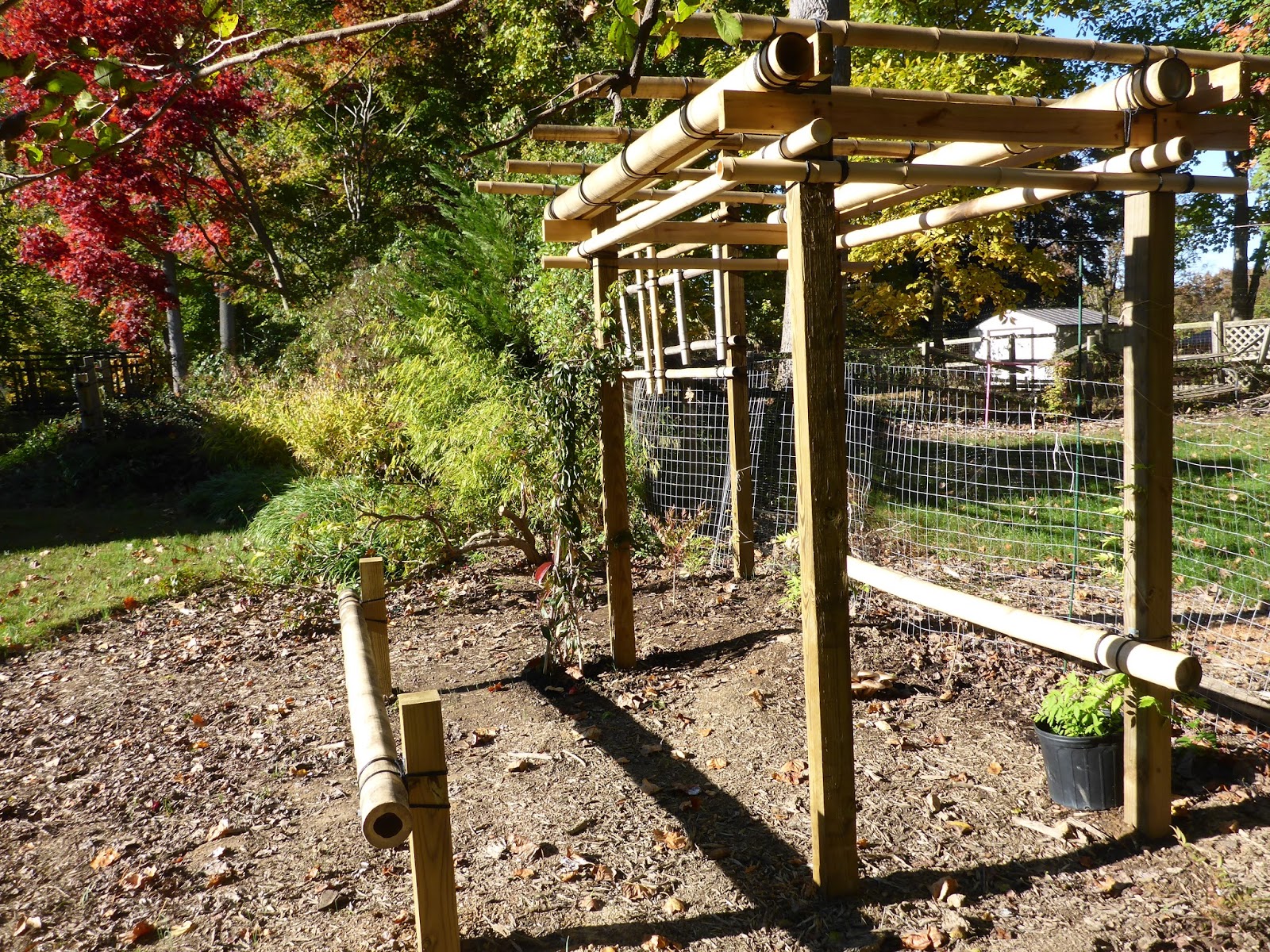
New planting bed and bamboo pergola


Decided that for future comparisons I needed another picture that shows the bedding area we're now planting and a better perspective on the new pergola, so I shot from our bathroom window.

Pergola, I've learned, is pronounced "per-GO-la."

Friday, October 23, 2015

Bamboo pergola

The uprooting of the oak tree this June destroyed a significant part of our backyard flower beds and some of the bamboo screening structures I built five years ago. We are in the process of replanting to restore the bedding areas, and I decided to replace one of the bamboo structures with a pergola:


We have planted vines that will be supported by the pergola.

Tuesday, October 20, 2015

Thinking about trees...

There's a couple of spots in the back yard that I've decided I want trees in, largely because we lost an oak in a June storm and I'd like to restore some of the lost shade and privacy.  Right now I'm thinking that rather than buy anything I'll relocate a holly and a magnolia which have sprung up on their own on our property. I realize that neither are likely to grow quickly because it's still rather shady back there, so I may decide on another solution.

However that decision goes, this time of year is a good time to be thinking about trees.  In the summer trees blend into a seemingly solid mass of green so that I'm not too conscious of the individual species.  In the winter with all the deciduous leaves down, differentiating among the types is more difficult.  It's the months of change, mostly in October and April, that the individuality stands out.

Saturday, October 10, 2015

Brookside Gardens this afternoon

It's so close, so I really should visit more often.

Tuesday, October 6, 2015

Reservoir still showing signs of drought

Despite the constant rain last week, Triadelphia water levels are way down. In spring when we put the canoe at its mooring lock-up, the reservoir water was touching the end of its 15 foot length. Now, the levels are about a boat length lower:


The reduced water level may improve the fishing as the fish are concentrated into a smaller volume of space. At least this fisherman hopes so:


Wednesday, September 30, 2015

Late season

Been out twice in the last few weeks. Drove up to the upper Monocacy two weeks ago which gave me a lot of bluegill action, especially in the first hour, but yielded no bass. It was on a Friday, and by afternoon I was joined by two other fishermen who likely were going after work.  They were both courteous and did not infringe on waters I was fishing, but in about a half dozen previous trips there this was the first time I'd seen any other fishermen at all.  I think my "secret spot' is secret no more, and this might be the reason I've had less luck there on the last two visits.

Last week, I drove to the Gunpowder River. Caught a brook trout which is an unusual catch for me.  It was small but beautiful.  I cut the trip short because my back was hurting.  The cause, I suspect, was the weight of my fishing vest.  I'll think about trying to reduce its weight by eliminating items I seldom use.

I haven't fished the pond lately, but I'm including this picture anyway.  We've received some rain in the over the past 24 hours, and the rain is predicted to continue through the weekend.  Then a hurricane might move in.  Hope not.

Monday, September 14, 2015

Pennyfield Lock and Muddy Branch

The wind made fly fishing difficult today on the Potomac, so I quit after two good-size bluegills on a surface bug. Although I had been on the river for a couple of hours, I spent more time wading than actually fishing. I then decided to hang around the C&O Canal drying off on this beautiful day.


A tributary, Muddy Branch, flows into the river just upriver from Pennyfield, and the engineers who designed the C&O Canal about 170 years ago had an easier time than they had upriver for the Monocacy since the required aqueduct for the much smaller Muddy Branch was much simpler:


During the Civil War, there was a major camp for Union soldiers along Muddy Branch.  Although I was unable to find out how many were stationed there, I seem to remember hearing during a course I took on Montgomery County archeology just after retiring that there were more Union soldiers in the county at the time than residents. I guess it was prudent to defend Washington with many troops especially since the county was generally pro-Confederate in sympathies.

Water levels were 2.9 at Little Falls which is about the same as they've been despite the heavy rain we received (finally) on Saturday.

Friday, September 11, 2015

"The sky is 9/11 blue..."

That's how Pam described it this morning, and it's true that today's sunny, clear sky is reminiscent of that terrible day 14 years ago.  I'm prone to superstition about weather and significant days. When I was young I thought Good Fridays always seemed to be rainy and gloomy.  They weren't always, of course, and even when they were, raining days are hardly unusual in the spring just as clear days of low humidity and bright sun are not unusual in the early fall.

Monday, August 31, 2015

Weary but satisfied

And I'm not certain why I had either of those two feelings Friday evening and much of the day Saturday.

The physical activity Friday was typical.  Four times I lifted the kayak on or off the car.  The drive to and from the river was about an hour.  The carry between the parking lot and the boat launch was only about ten yards, and the paddle out to the gravel bar was about a half mile with the last 40 feet or so pulling the kayak through water only ankle deep.  Except for a short break for a trail mix lunch, the rest of the trip was fly-casting in waist deep water and moving through an area roughly the length and width of a football field.  All very typical of my favorite kind of fishing trip.

Even though this is my favorite fishing, fly fishing for smallmouth bass on the Potomac River, the particular satisfaction I felt about Friday isn't clear to me either.  Objectively, the number  and size of fish I caught were certainly not exceptionally good; two average-size smallmouths in four hours of fishing isn't anything to brag about. However, these two fought hard, jumped multiple times and looked beautiful to me as I unhooked and released them back in the water. 

Maybe the satisfaction came from eventually getting results by paying attention to what was going on around me, the number of insects in the air and water and the occasional feeding rise of the fish to them.  I started with a surface slider, switched to a hackled dry fly, then tried a couple of subsurface flies before switching back to the same slider I started with because it seemed to arouse the most interest even though I hadn't landed anything yet.  And there were those rises, not many but regular. Maybe having persistence rewarded was part of the satisfaction.

After returning home from the Mouth of the Monocacy parking lot and putting away the kayak and tackle, I wasn't good for much activity for the remainder of the day or the following day either.  When I wondered why I was so tired, Pam suggested maybe it was old age.  Could be.  Water levels were 1.1 at Point of Rocks and 2.8 at Little Falls which are both common readings for this time of year.  The past month or so has been dry.

Sunday, August 23, 2015

Bethany Beach last week


Excellent weather, excellent company with wife Pam, daughter Rebecca, and son-in-law Sean.

Thursday, August 13, 2015

Time, place, and presentation

These are three of the variables that fishermen consider, and when I paused for lunch on a gravel bar in the Potomac near Nolands Ferry yesterday I first wondered about place.  I didn't think too seriously about my poor showing during my first smallmouth trip to Pennyfield Lock a week or two earlier because that had been a Monday on a stretch of the river that gets fished hard on weekends.  Then at least I caught a few bluegills, but my fishless morning yesterday got me wondering if there was something dreadfully wrong with the river.

When my floating fly didn't produced, I tried a large crystal bugger which I tried on both sides of the island but that didn't work either.  I switched to a B&B, a smaller fly that doesn't run as deep as the bugger and got a few takes which came off.  On the last half hour of fishing in the afternoon, I finally landed a few fish, a couple of smallmouths, my first of the season, and a bluegill.  That got me musing about the other two variables:  time and presentation.  Was the success due to presentation, fishing the right fly at the right depth?  Or did the fish suddenly decide the time was right to come out of their stupor and become more aggressive?  The fish don't say, so it's left to us fishermen to think about these things.

There was just time enough to take a picture of the river on a beautiful August day.  Water levels were 2.9 at Little Falls and 1.3 at Point of Rocks.

Monday, August 3, 2015

A description of a legend's music that captures it for me

"...there was just something different in Mr. Williams's music, the way some paintings are more vivid, more real than others..."

This was from Rick Bragg's book Jerry Lee Lewis: His Own Story writing not about Jerry Lee but about Hank Williams.  For years I've tried to express what stands apart about Hank Williams's music, and I admire how Bragg puts it. His words about Williams's music also describe the way I feel about Hemingway's writing about fishing and the outdoors as compared with the thousands of words I've read from other writers, many of them quite skilled.

Lately Pam has brought back from the local library a number of memoirs and biographies of musicians- Herbie Hancock, Carlos Santana, Gil Scott-Heron, and all contained some worthwhile reading, but Rick Bragg's book about Jerry Lee has been the most fun.  He has an incredibly colorful subject, the expression "larger than life" actually seems too tame to describe someone as outlandish as Jerry Lee Lewis. Bragg is a skillful writer and, also from the deep south, he has a feel for its land and people.  He made me wonder if another place or time could have produced a Jerry Lee.

Bragg has a southerner's gift for story-telling, and his subject's antics over the years produces many great stories.  Since reading this book, I can't help passing on some of these stories to my friends and family at any opportunity.